

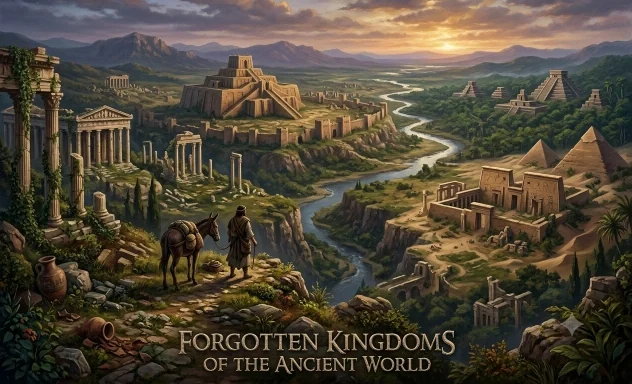
History often focuses on famous civilizations such as Egypt, Greece, and Rome. However, many powerful and fascinating kingdoms once flourished before fading from popular memory. These forgotten kingdoms of the ancient world played important roles in trade, culture, politics, and technological development. Exploring their stories helps us gain a deeper understanding of human civilization and the diversity of ancient societies.

Why Some Kingdoms Are Forgotten?
Many ancient kingdoms disappeared due to conquest, environmental changes, economic decline, or political instability. Over time, their achievements were overshadowed by larger empires or lost through the destruction of historical records.
Modern archaeology continues to uncover evidence that reveals the importance of these once-thriving civilizations.
The Kingdom of Kush
Kingdom of Kush flourished south of ancient Egypt in the region of Nubia.
Known for:
- Wealth from trade
- Skilled metalworking
- Powerful military forces
- Distinct cultural traditions
At certain points in history, Kushite rulers even governed Egypt, demonstrating the kingdom’s regional influence.
The Kingdom of Urartu
Urartu emerged during the first millennium BCE near present-day Armenia and eastern Turkey.
The kingdom became known for:
- Advanced irrigation systems
- Fortified cities
- Agricultural development
- Military strength
Although eventually absorbed by neighboring powers, Urartu contributed significantly to regional history.
The Nabataean Kingdom
The Nabataean Kingdom controlled major trade routes connecting Arabia, Africa, and the Mediterranean.
Its capital city, Petra, remains one of the world’s most impressive archaeological sites.
The Nabataeans excelled in:
- Water management
- Commerce
- Architecture
- Long-distance trade
The Kingdom of Aksum
The Kingdom of Aksum became a major trading power between Africa, Arabia, and Asia.
Aksum was known for:
- Monumental stone structures
- Maritime trade
- Coin production
- Cultural influence
It played an important role in connecting ancient civilizations across regions.
The Kingdom of Lydia
The Kingdom of Lydia achieved prosperity through trade and innovation.
Lydia is often credited with introducing some of the earliest standardized coinage systems, which influenced commerce throughout the ancient world.
The Kingdom of Mitanni
Mitanni flourished during the second millennium BCE.
Its influence extended across parts of modern-day Syria and Iraq. Mitanni became known for its diplomacy, military expertise, and horse-training techniques.
The Kingdom of Punt
The Land of Punt remains one of history’s most mysterious civilizations.
Ancient Egyptian records describe Punt as a wealthy trading partner that supplied valuable goods such as incense, gold, and exotic animals.
Its exact location continues to be debated by historians and archaeologists.
Trade and Cultural Exchange
Many forgotten kingdoms became prosperous because they controlled strategic trade routes.
Trade facilitated:
- Economic growth
- Cultural interaction
- Technological innovation
- Diplomatic relationships
These kingdoms often served as bridges connecting distant regions and civilizations.
Rediscovering Ancient Kingdoms
Archaeological discoveries continue to shed light on forgotten civilizations. Excavations, inscriptions, and technological advances allow historians to reconstruct the histories of societies once believed lost.
These discoveries expand our understanding of the ancient world beyond the most famous empires.
Lessons from Forgotten Civilizations
Studying lesser-known kingdoms teaches valuable lessons about:
- Cultural diversity
- Political development
- Economic innovation
- Human adaptability
Their stories demonstrate that many societies contributed to human progress, even if they are less widely remembered today.
Conclusion
The forgotten kingdoms of the ancient world reveal a rich and diverse history that extends far beyond the most famous civilizations. Kingdoms such as Kush, Aksum, Urartu, Lydia, and the Nabataeans played important roles in trade, culture, and innovation. By exploring these overlooked societies, we gain a fuller understanding of humanity’s shared past and the remarkable achievements of ancient peoples across the globe.








Leave a Reply