

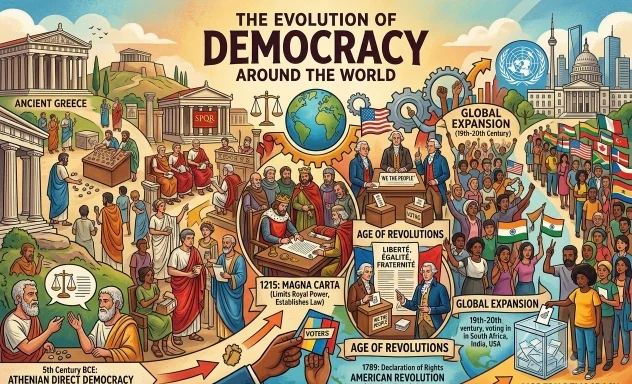
Democracy is one of the most influential forms of government in modern history. Based on the principle that citizens should participate in political decision-making, democracy has evolved significantly over the centuries. From ancient assemblies to modern electoral systems, the evolution of democracy worldwide reflects humanity’s ongoing pursuit of representation, accountability, and political freedom.

What Is Democracy?
Democracy is a system of government in which political power is derived from the people. Citizens typically participate through voting, public debate, and civic engagement.
Core democratic principles include:
- Free and fair elections
- Rule of law
- Protection of rights
- Political participation
- Government accountability
While democratic systems vary between countries, these principles remain fundamental.
Ancient Origins
The roots of democracy are often traced to Athens during the fifth century BCE. Citizens participated directly in decision-making through public assemblies.
Although participation was limited to certain groups, the concept of citizen involvement laid the foundation for future democratic developments.
Democratic Ideas During the Enlightenment
The Enlightenment period introduced new ideas about government, liberty, and individual rights. Thinkers argued that political authority should come from the consent of the governed rather than from hereditary rulers.
Important concepts included:
- Separation of powers
- Individual freedoms
- Constitutional government
- Popular sovereignty
These ideas influenced democratic movements around the world.
Democratic Revolutions
Several major revolutions helped spread democratic principles.
Notable examples include:
- American Revolution
- French Revolution
These events challenged traditional systems of governance and promoted ideas of citizen representation and political rights.
Expansion of Voting Rights
Early democratic systems often limited voting to property owners or specific social groups. Over time, many countries expanded suffrage to include broader populations.
- Removal of property requirements
- Women’s voting rights
- Expanded civil rights protections
- Universal adult suffrage
These changes made democratic participation more inclusive.
Growth of Representative Democracy
As nations grew larger, direct democracy became less practical. Representative democracy emerged as a system in which citizens elect officials to make decisions on their behalf.
Representative institutions include:
- Parliaments
- Congresses
- Legislative assemblies
This model became widely adopted across democratic nations.
Democracy After World War II
The end of World War II accelerated democratic development in many regions. New constitutions, international organizations, and human rights frameworks promoted democratic governance.
Important developments included:
- Democratic reconstruction efforts
- Decolonization movements
- Expansion of political rights
- Strengthening of international cooperation
Many newly independent nations adopted democratic systems during this period.
Democratic Transitions in the Late Twentieth Century
The late twentieth century witnessed significant democratic expansion.
Major developments included:
- The fall of authoritarian governments
- Democratic reforms in Eastern Europe
- Increased political participation worldwide
- Growth of independent media
These changes contributed to a broader global movement toward democratic governance.
Challenges Facing Modern Democracies
Despite its growth, democracy continues to face challenges.
Current concerns include:
- Political polarization
- Misinformation
- Corruption
- Voter disengagement
- Threats to institutional independence
Addressing these issues is important for maintaining public trust and democratic stability.
The Future of Democracy
Technology, globalization, and changing social expectations continue to influence democratic systems. Governments increasingly explore new ways to encourage civic participation while adapting to modern challenges.
Potential developments may include:
- Digital voting systems
- Enhanced public engagement
- Greater transparency initiatives
- Expanded civic education programs
The future of democracy will likely depend on balancing innovation with the protection of democratic principles.
Conclusion
The evolution of democracy worldwide demonstrates humanity’s ongoing effort to create governments that reflect the will of the people. From ancient assemblies to modern representative systems, democracy has continually adapted to changing societies and political realities. While challenges remain, democratic principles continue to play a central role in shaping governance, protecting rights, and promoting citizen participation across the globe.






Leave a Reply